Who remembers Hannah’s Sweets?
In 2015, it was the final year of the “old GCSE”. Teachers were discussing the new GCSE (yes, the one we will soon be replacing again).
One of the main complaints about the “old” maths GCSE was that it had been dumbed down and that the exam papers had become incredibly predictable. Low pass marks on the higher tier resulted in students being entered for the papers while only being able to access 50% of the questions and needing only about 30% to pass. Questions that might once have been original or interesting were now just being taught as a recognition and memory task. Refrains such as “If you see the words cumulative frequency, remember you’re drawing a snake” were ubiquitous. These were not better times for maths teaching.
Now along came Edexcel and set Hannah’s Sweets. I don’t know if they wanted to prove a point that they could still set original problems, whether they wanted to give a middle finger to the educational establishment, or if they just liked the question. But Hannah’s Sweets certainly caused ripples. It was the early days of teenage lives being lived on social media. It was one of the first maths questions that went truly viral. All the newspapers covered it, it made the BBC News, and Edutwitter (remember that?) went wild. Every year since, an exam has made waves online; this year, a petition was started because the A-level exam was somewhat harder than students wanted it to be.
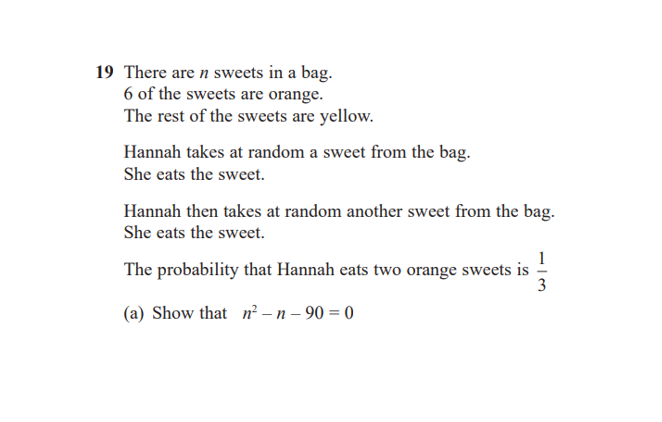
“Hannah’s Sweets” Edexcel GCSE Mathematics 2015 Paper 1 Higher
Hannah having sweets in a probability context should have been such an easy question. Then they hit you with “Show that n²−n−90=0”. The juxtaposition between the simple context and the abstract algebra. It’s obviously hilarious, isn’t it? We had to wait until part (b) before they even asked us how many sweets were in the bag.¹ Such a false context. If we’re discussing problem-solving, then it certainly caused a problem with my students. The main problem was that none of them could do it.²
I have reason to come back to Hannah’s Sweets, though, beyond just making dry critical comments about everyone involved. At the time, it failed as a question for most students because they didn’t have the mathematical ability to solve it. Many students struggled with probability involving multiple events and had just crammed a “probability tree diagram” without understanding it; similarly, many students had probably skipped the quadratics chapter altogether, having been urged to “just get to the staples”. They were problem-solving with material far too hard for them.
It’s over 10 years later now; the situation has changed. Hannah’s Sweets, once such an original problem, almost laughably difficult, now contains maths that has become standard.
Teachers, rightly, prepare students for the patterns and exam board habits that they know students might encounter. Resources have now proliferated, allowing students to rehearse and drill answers to algebraic probability questions.
Dr Austin is one of the most prolific creators of quality maths resources around at the moment. She’s created this:
https://www.draustinmaths.com/_files/ugd/7ac124_c9f9f3cff8a54eeca538d59069601d2e.pdf
John Corbett is ever-present and deserves some kind of lifetime achievement award for resource creation. He’s created this (scroll to the bottom):
https://corbettmaths.com/wp-content/uploads/2019/04/Tree-Diagrams.pdf
The GCSE Maths Tutor creates online videos. This one has over 100k views (not bad for 45 minutes on algebraic probability):
https://www.youtube.com/watch?v=BsmwXW5uQrY
This year’s version is still embargoed (I know that’s effectively meaningless in the days of social media), and I’m not meant to comment too specifically as an examiner for the paper. But there was certainly no media outcry about this year’s probability equation question, and I can promise you it was much harder. However, now that students are prepared so thoroughly for questions of this kind, it isn’t really problem-solving. Most students entered for the higher paper nowadays have stronger maths (previous staple chasers are mostly being entered for the foundation tier). Quadratics and probability are generally taught a bit earlier in the course.
Don’t get me wrong, I’m not blaming anyone. These resource creators are doing a great job, and the teachers are doing right by their pupils. I had a foundation class last year, but if I had had a higher one, I too would have prepped my students for this question type. Now we know there’s a good chance this can come up, it would be letting our students down to leave them unprepared. If students are facing unfamiliar problems in their exams, they are at a distinct disadvantage when compared to peers who have been prepared for those same questions.
It seems to me that there is a clear conflict. To be a good maths teacher, we want our students to be good problem solvers. But to be a good maths teacher, we want our students to encounter as few original problems as possible in their exams.
It’s sad, but true. I feel like I want to be that bloke sat in a chair with a sign that says, “Convince me I’m wrong.”
¹ You know full well that was all one question without part (a), until it was tested on children who all either left it out entirely or just solved it by trial and error. Sorry, in the context of 2015, perhaps I should say ‘trial and improvement’.
² That’s actually unfair. I taught a wonderful class that year, who I still remember fondly, and loads of them did well in that series of exams.