My evolving thoughts about teaching problem solving
I’ve recently been thinking about “problem solving” in maths. I’ve been participating in the NCETM Secondary Mastery Specialist Programme and, in one of the sessions, we discussed problem solving.
Every maths teacher has been in a meeting like this. They follow a pattern. Someone inevitably points out that a problem is only a problem if a student hasn’t already been shown how to do it; this isn’t incorrect, but it is a fairly obvious observation. Someone else distracts the group with a particularly tricky problem they once set a top set. Someone else complains that their Year 7s don’t know enough numeracy to problem solve. Someone else Googles “problem solving maths lesson TES”. We all get bored.
Nothing that follows is particularly original, but apparently that hasn’t stopped me writing it down.
It’s fair to say I was a sceptic. The idea of teaching problem solving has always seemed nebulous to me. Of course we want students to be able to solve unfamiliar problems, but my experience was that students who knew more maths were better at doing so. The solution seemed obvious: teach them more maths and they will become better problem solvers.
My scepticism has been reinforced throughout my career, especially during teacher training, by observing plenty of awful problem-solving lessons. They generally go one of two ways.
A teacher sets an immensely broad and often very difficult task. Students are unclear about what they are meant to be doing. If they work that out, they don’t have the foggiest idea how to do it. Most give up. The odd one or two persist (the ones the teacher is helping), but even they disappear down a rabbit hole, approaching the problem inefficiently at best and incorrectly more often. The teacher urges students to “be resilient” or “keep trying”, perhaps offering insights such as “highlight the keywords”. On a good day, the teacher reveals a solution. Bonus points if an A2 sheet of sugar paper and half a dozen non-erasable markers have been crowbarred into the lesson.
A teacher sets what they consider to be a problem. The question is normally chosen because it contains more than one sentence or requires more than one line of working. The lesson comes at the end of a topic, and the “problems” are direct applications of material covered in immense detail during the preceding lessons. The teacher then demonstrates exactly how to solve it before giving students half a dozen near-identical questions. Students end the lesson no nearer to being able to solve an unseen problem.
Most problem-solving lessons I have observed have therefore been either entirely unproductive or not really problem solving at all. Quite often, they have managed to be both. Please don’t think I’m insulating myself from criticism. As bad as those lesson types both are, they are arguably better than my problem-solving lessons, mostly because I never did any problem-solving lessons. Of course I would present problems, but normally those that arose naturally as a part of teaching; if students struggled, I reverted to trying to teach the underlying subject matter better.
My thoughts recently have mellowed. I have not changed my mind about the importance of procedural and conceptual knowledge. No collection of generic tips can compensate for not knowing enough maths. The discussion in this regional hub mastery meeting, prompted in part by an ATM article by Colin Foster, caused me to think again.
First, we need to address the level of challenge. If students can’t complete the maths involved in a problem, they have no chance of solving it. The article addresses this directly.
“When learning a language, students do not spontaneously and fluently use the vocabulary they have just learned. It needs time to bed in. Similarly, if we want students to make sophisticated use of what they know, it might be better to rely on mathematical content that was learned some time ago and is quite robustly known. Content learned 2 years previously is a rough rule sometimes used at the Shell Centre in Nottingham.” Foster, 2019
There are added benefits to using maths learnt years previously. It removes the temptation for a teacher to present problems only with material that has been taught immediately before. It also provides a natural opportunity for students to retrieve and remember topics that have been taught, encouraging this idea of continual revision and review as opposed to last-minute cramming.
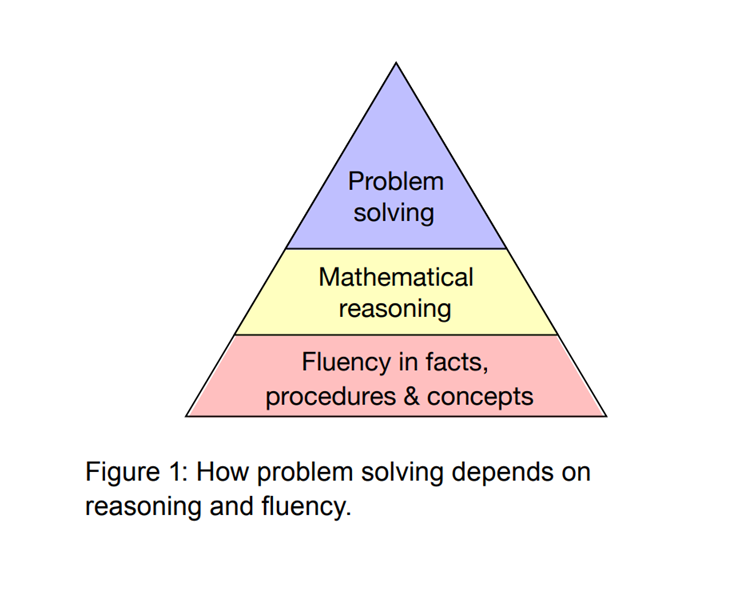
The fundamental issue with teaching problem solving. (Foster 2019)
In the discussion that followed, we were encouraged to think about problem solving as explicitly teaching subject-specific problem-solving techniques. Not generic platitudes, but actually identifying, naming, rehearsing and providing practice with tactics expert problem solvers use. It felt to me almost like letting the students into our secrets. The example the discussion focused on was ‘drawing an auxiliary line’, but there are plenty of other tactics, aren’t there: drawing a sketch, using a variable, working systematically. It seems obvious to me now. The aha moment for me was realising that teaching these tactics is a vital part of teaching the disciplinary knowledge in our subject.
Of course I’ve always encouraged students to draw an auxiliary line. If there’s an L-shaped hexagon or an exterior angle, I’m all over it. But I probably haven’t stressed it as a strategy for when the route to a solution is not apparent. It isn’t about new substantive content, but deploying existing knowledge. Previously, I used to assume that experts made these moves simply because they had expertise and it was my job to make students more expert. I am now more persuaded that at least some of them can be taught and learned, or at least I should give it a chance.
It’s easier said than done. I’ve only just started and bumped into all sorts of challenges.